Sunday, October 21, 2007

Copywriting

Copywriting
Copywriting is defined in the Wikipedia as "the process of writing the words that promote a person, business, opinion, or idea. It may be used as plain text, as a radio or television advertisement, or in a variety of other media. The main purpose of writing this marketing copy, or promotional text, is to persuade the listener or reader to act — to buy a product or subscribe to a certain viewpoint, for instance. Alternatively, copy might also be intended to dissuade a reader from a particular belief or action."

"Copywriting can include body copy, slogans, headlines, direct mail pieces, taglines, jingle lyrics, World Wide Web and Internet content, television or radio commercial scripts, press releases, white papers, and other written material incorporated into advertising media. Copywriters can contribute words and ideas to print ads, mail-order catalogs, billboards, commercials, brochures, postcards, online sites, e-mail, letters and other advertising media."

The art of writing an advertising copy is based on the assumption that words can change the thinking, attitudes, beliefs, and behavior of an audience. If the writings in a copy fail to provoke attention, interest, desire, conviction, and action, it has failed its task and intent.

One of the oldest advertising copywriting formulae is AIDA: Attention, Interest, Desire, and Action. An ad that does not gain the attention of the reader will not to be able to do anything else. Only after catching attention can an ad arouse the interest of the consumer and create the desire for the product, service, or idea presented. Finally, the ad should stimulate some action by the customer, otherwise, it has failed in its purpose.

Some techniques a copywriter can use in writing persuasive ad copies include:

  • Cliches or buzzwords, such as, now, new, here, at last, and today.
  • Action words, such as, buy, try, ask, get, send, taste, watch, look, come, and many more.
  • Emotive or exciting words, using adjectives that enhance facts, such as, splendid, amazing, delightful, beautiful, and wonderful.
  • Alliteration or a form of repeating sounds pleasing to the ear, but not overdone, obvious, or irritating, such as, 'Let the train take the strain,' 'Don't be vague, ask for Haig,' and 'Go well, go Shell'.
  • Colloquialisms or writing to imitate informal speech, such as, 'Pick 'n Choose', 'Fish 'n Chips', and the use of words, such as, don't, wouldn't, won't, what's, and other abbreviations.
  • Punctuations and grammar, such as, 'Save the children. Now.' 'Write his name in gold. Remy Martin.'
  • Repetition, such as, the use of same word to open each paragraph, plugging brand or company name throughout the text.
  • Intertextuality or the association of a text to other texts or signs, such as the use of the word 'lock' to associate with security, or the use of a statement, term or sign from a movie or other media.

When writing a Headline for a print ad, consider the following guidelines:

  • Make the headline a major persuasive component of the ad
  • Appeal to the reader's self-interest with a basic promise of benefits
  • Inject the maximum information without making it cumbersome or wordy
  • Limit headlines to about 5 to 8 words
  • Include the brand name in the headline
  • Entice the reader to read the body copy
  • Entice the reader to examine the visual in the ad
  • Never change the typeface in a headline
  • Never use a headline whose persuasive impact depends on reading the body copy
  • Use simple, common, familiar words

When writing the Subhead, consider the following:

  • Subhead should reinforce the headline
  • Subhead should entice the reader to proceed to the body copy
  • Subheads should stimulate a more complete reading of the entire ad
  • The longer the body copy, the more appropriate the use of subheads
  • Keep the use of subheads to minimum - they can clutter an ad
When writing the Body Copy, consider the following:
  • Use present tense whenever possible
  • Use singular nouns and verbs
  • Use active verbs
  • Use familiar words and phrases
  • Vary the length of sentences and paragraphs
  • Involve the reader
  • Provide support for the unbelievable
  • Avoid clichés and superlatives
Some common mistakes to be avoided in copywriting include:
  • Vagueness, resulting from generalization of words or imprecise meanings.
  • Wordiness, where economy of words is paramount because a copy has to fit within limited space and time before it bores the audience.
  • Triteness or unoriginality, where the use of clichés and worn out superlatives can create a dull and outdated image for a brand or firm.
  • Beyond Creativeness, where creativity is taken overboard for the sake of creativity. A copy must remain true to its primary responsibility: communicating the selling message.
Writing a good copy requires much more than what is mentioned in this article. It requires research, thinking out of the box, and many other aspects. For more tips on copywriting, check out the many resources available on the web and read the relevant books by professional copywriters.

Tuesday, August 14, 2007

Translations

I can now better understand why books with different translations appear at time to vary in content or context.

In recent months, I have the opportunity to translate and edit several articles of different languages into English with the help of online translators. Some of the languages for translation include French, Italian, Hungarian, and Japanese.

One of the greatest difficulties I faced in translating the languages is the many varied meanings of a word. Take French for example. The word 'apres' or 'a pres' is translated by the different online translators as 'after' or 'near'. A sentence such as the following:

Après ses casinos, le groupe Louvre Hôtels souhaitait également offrir aux clients de son hôtelier un accès Wi-Fi gratuit

therefore, can be translated as:

After its casinos, the group Louvre Hôtels also wished to offer to the customers of its hotel free Wi-Fi access

or

Near its casinos, the group Louvre Hôtels also wished to offer to the customers of its hotel free Wi-Fi access

This sentence, which is at the start of a new paragraph, however appears incorrectly translated, based on the structure and preceding paragraphs which made no mention of what is before, hence, 'after' cannot be used. The word 'near' seems logical, but in understanding the context, does not seem to fit the starting point of a new paragraph, so a French to English dicitionary was consulted.


Apart from the meanings 'after' and 'near', the dictionary also defines 'apres' as 'in front of', which put the whole context of the sentence in different light. The plausible meaning of the abovestated sentence therefore can be translated as:

In front of the casinos, the group Louvre Hôtels also wished to offer to the customers of its hotel free Wi-Fi access

Having determined 'in front of' to be the 'correct' translation, most of us will automatically assume the same word 'apres' used at the beginning of the next paragraph means the same thing, but this is far from the truth and presumptious, as in the case of the article I was editing. Reading through the context of the new paragraph:

Après un état des lieux et une série de tests en réel, c’est la gamme sans fil AirPremier qui a été retenu pour répondre totalement aux contraintes techniques Wi-Fi des hôtels

the correct translation will appear to mean 'after' rather than 'in front of', as in the case of:

After an inventory of fixtures and a series of testing in 'live' environment, it is the wireless AirPremier which was retained to answer completely the technical constraints Wi-Fi of the hotels

Following this thread of discussion, it is clear that translations and interpretations can differ in context. This is probably why different translations and versions of the Holy Bible can sometime appear to be different in interpretation of certain passages and verses in specific context. When read as a whole, however, the focus of the Bible is essentially the same, and it is our attitudes as the reader in understanding the truth within that is important.

Online Translation Tools:
www.google.com/translate_t
www.worldlingo.com/en/products_services/worldlingo_translator.html
www.freetranslation.com/
www.translation-guide.com/free_online_translators.php?

Tuesday, March 20, 2007

News and Media Archives

News agencies often use archived pictures and video clips for re-publishing in general news articles. This method of placing back-dated clips or pictures however can mislead audience to perceive the visuals as occurring only recently.

Just yesterday, a friend of mine was perturbed when she saw her picture appear in an article of a local newspaper which was taken by the press two years ago for an event. Although the picture from the archive is appropriate for the theme of the article in illustrating the dependency of good teacher-pupil relationship in providing effective teaching, it is seemingly 'incorrect' to portray it as part of a recent news relating to a subject discussed in Parliament concerning a new method of assessing teachers under the Enhanced Performance Measurement System, especially when it is published without prior permission from the person in the picture. This, however, is how it is with news reporting. Where a piece of news has been accepted for publishing by the press, all its content essentially becomes the property of the news agency, in which the agency reserve all rights to do anything they want with it. Such content once published is deemed to be for the 'public' eye, hence, can no longer be considered private, which would require the agency to seek permission before re-publishing. However, if the picture is being misused to convey something not relating to the original intent, the matter can then be brought up for scrutiny.

Take the example of the news station that presented an archived video clip of the celebration by Iraqis after the September 11, 2001 event where the twin World Trade Center towers were destroyed in New York. This piece of news was telecast throughout the world and created much hatred, resulting in Gulf War II. The video clip in question, however, is not shown 'live' from Iraq, but from an archive in the library. In reality, nothing of that celebration took place, yet by telecasting the clip immediately after showing the video of what happened to the World Trade Center, audience's perception was misplaced, resulting in hate.

The issue being discussed here is not to determine the extent in which the journalism code must be adhered or about what is and what is not ethical. It is about how audience must perceive news that is found in the newspapers and television news. To this end, my hope is for all of us as readers of news, to learn to see beyond what is written in the text, so as to decipher for ourselves what is true and untrue, what is real and unreal, and what is right or wrong.

Monday, October 02, 2006

Historical Writings

Something I've learnt over a hermenuetics class this week is that 'history' is not the same as 'historiography'. History is what actually happened in the past, while historiography, as defined in the Oxford Dictionary, is "the writing of history", which is a way of portraying or telling what had happened during actual events.

The way a writing or message is conveyed in historiography involves the perspective of the author, which can be selective in content (John 20:30-31). Depending on the message the author wish to convey or achieve, a text is chosen to tell the story of the event. This, of course, does not mean the event did not take place, but rather it means history or the event can be told differently by different people, depending on the individual's perspective and objective.

For example, when Matthew wrote the gospel, it was to the Jews, so many Scriptural verses of the Old Testament were quoted. Mark, on the other hand, wrote to the Romans, so the word 'immediately' is frequently seen, because the Romans were the ruling party at that time, thus a sense of immediacy was depicted to show action.When reading the Bible, therefore, there are occasions where people see it contradictory in content, but in actual fact, it is merely the difference in perspective and objective. What is needed when reading God's word, therefore, is for us to put ourselves in the context of the time the text is written, and read its content through the eyes of the author, constantly remembering that:

"All Scripture is inspired by God and profitable for teaching, for reproof, for correction, for training in righteousness;" (2 Timothy 3:16 NAS)

Friday, September 22, 2006

Effects of Online Media

In media studies, we often argue about the effects of the media. Many advocators say the advent of media technologies help provide benefits of knowledge through abundance of information. Sociailists, on the hand, see it as a greater evil in influencing people, in controlling and seducing the community.

Take the example of online communities like Hi5, Friendster, MySpace and others. Many boast of the benefits in getting to know more friends online, while others feel they have been sucked in to cyber intoxication of impurities, of virtual unholiness. Take a look at the pictures people post at their profile in online communities. These pictures range from cartoons to sexy photos, and some others, inappropriate content. People get led to become another friends because of the photos, and these photos may not even be the persons they are communicating with. These photos are mere representations, or what is know as avatars.

An avatars is, according to the Cambridge Dictionary, "an image which represents you in online games, chat rooms, etc." This means, essentially, a picture which is not you, placed anywhere online in the Internet or the World Wide Web, to represent you.

These days, however, most of the images at online communities are actually avatars, where 'cool' pictures of people who generally borrowed identities from other people's photographs pose as themselves. Maybe the real person ain't handsome or pretty, but to have images that attract another so as to make friends is not exactly what I would have like, but then again, maybe they have something to hide. Avatars or not, I am generally open to accepting people as they are.

So, readers, what do you say? Are online communities good or evil? My opinion is, where there is anything bad, there must always be some good. Without improvements in technology, communication would have been difficult, and fulfilling the task of the Great Commission would have been difficult. As a faith deliverer and writer, I am now able to
reach the world, just by merely writing or blogging on the Net.

Wednesday, August 09, 2006

Practical Skills in Photo Journalism

To be a good photo journalist is not easy. You'll need to be at the right place at the right time, see your surroundings differently from others to know what makes a story, and be quick to capture moving objects or events. This essentially means you'll always need to have a camera at hand wherever you go.

Many times photos for the front page news bear pictures of event aftermath, and such photos are usually not good enough because they do not depict the story, but only tell what have happened earlier. Candid on-the-spot pictures of actual event, on the other hand, need little narrative as they tell the story visually. Theories of photo journalism frequently emphasize the ethical aspect of presenting the truth of a photo as is, rather than crop or make it seem to convey other messages. What you see in photographs, however, in reality are not truths as represented. It is alright to use digital capabilities to enhance pictures, but it is unethical to modify content.

If you are considering a job in photo journalism, first consider what it entails, then hone your skills to live life in action, fine-tuning your instinct and making changes in perception, to sense the story behind every event and every important person.

Thursday, July 20, 2006

Blog A Job

About two weeks ago The Straits Times in Singapore quoted a news story from the New York Times concerning the reviewing of potential employees' blogs by employers.

In the story, a graduate with great potentials and outstanding results was denied a job after a potential employer discovers the graduate's blog containing some questionable remarks or inapporiate content.

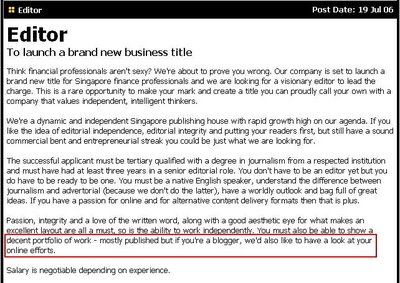
Blogging as a way to find a job is not uncommon these days. Not too long ago, a Singaporean blogger was hired to be press writer for a local newspaper because of her 'famous' or 'infamous' blog. Just recently, I came across an advertisement at JobsDB.com that mentioned the following as a criteria for the position of an Editor:

You must also be able to show a decent portfolio of work - mostly published but if you're a blogger, we'd also like to have a look at your online efforts.

These days, online writing can be used for many purposes, and getting hired is certainly one noble way of using our writing skills to make a living!

ShareThis