Something I've learnt over a hermenuetics class this week is that 'history' is not the same as 'historiography'. History is what actually happened in the past, while historiography, as defined in the Oxford Dictionary, is "the writing of history", which is a way of portraying or telling what had happened during actual events.
The way a writing or message is conveyed in historiography involves the perspective of the author, which can be selective in content (John 20:30-31). Depending on the message the author wish to convey or achieve, a text is chosen to tell the story of the event. This, of course, does not mean the event did not take place, but rather it means history or the event can be told differently by different people, depending on the individual's perspective and objective.
For example, when Matthew wrote the gospel, it was to the Jews, so many Scriptural verses of the Old Testament were quoted. Mark, on the other hand, wrote to the Romans, so the word 'immediately' is frequently seen, because the Romans were the ruling party at that time, thus a sense of immediacy was depicted to show action.When reading the Bible, therefore, there are occasions where people see it contradictory in content, but in actual fact, it is merely the difference in perspective and objective. What is needed when reading God's word, therefore, is for us to put ourselves in the context of the time the text is written, and read its content through the eyes of the author, constantly remembering that:
"All Scripture is inspired by God and profitable for teaching, for reproof, for correction, for training in righteousness;" (2 Timothy 3:16 NAS)

Journalism n Writing ... editorial discourses, commentaries, and thoughts
Monday, October 02, 2006
Friday, September 22, 2006
Effects of Online Media
In media studies, we often argue about the effects of the media. Many advocators say the advent of media technologies help provide benefits of knowledge through abundance of information. Sociailists, on the hand, see it as a greater evil in influencing people, in controlling and seducing the community.
Take the example of online communities like Hi5, Friendster, MySpace and others. Many boast of the benefits in getting to know more friends online, while others feel they have been sucked in to cyber intoxication of impurities, of virtual unholiness. Take a look at the pictures people post at their profile in online communities. These pictures range from cartoons to sexy photos, and some others, inappropriate content. People get led to become another friends because of the photos, and these photos may not even be the persons they are communicating with. These photos are mere representations, or what is know as avatars.
An avatars is, according to the Cambridge Dictionary, "an image which represents you in online games, chat rooms, etc." This means, essentially, a picture which is not you, placed anywhere online in the Internet or the World Wide Web, to represent you.
These days, however, most of the images at online communities are actually avatars, where 'cool' pictures of people who generally borrowed identities from other people's photographs pose as themselves. Maybe the real person ain't handsome or pretty, but to have images that attract another so as to make friends is not exactly what I would have like, but then again, maybe they have something to hide. Avatars or not, I am generally open to accepting people as they are.
So, readers, what do you say? Are online communities good or evil? My opinion is, where there is anything bad, there must always be some good. Without improvements in technology, communication would have been difficult, and fulfilling the task of the Great Commission would have been difficult. As a faith deliverer and writer, I am now able to reach the world, just by merely writing or blogging on the Net.
Take the example of online communities like Hi5, Friendster, MySpace and others. Many boast of the benefits in getting to know more friends online, while others feel they have been sucked in to cyber intoxication of impurities, of virtual unholiness. Take a look at the pictures people post at their profile in online communities. These pictures range from cartoons to sexy photos, and some others, inappropriate content. People get led to become another friends because of the photos, and these photos may not even be the persons they are communicating with. These photos are mere representations, or what is know as avatars.
An avatars is, according to the Cambridge Dictionary, "an image which represents you in online games, chat rooms, etc." This means, essentially, a picture which is not you, placed anywhere online in the Internet or the World Wide Web, to represent you.
These days, however, most of the images at online communities are actually avatars, where 'cool' pictures of people who generally borrowed identities from other people's photographs pose as themselves. Maybe the real person ain't handsome or pretty, but to have images that attract another so as to make friends is not exactly what I would have like, but then again, maybe they have something to hide. Avatars or not, I am generally open to accepting people as they are.
So, readers, what do you say? Are online communities good or evil? My opinion is, where there is anything bad, there must always be some good. Without improvements in technology, communication would have been difficult, and fulfilling the task of the Great Commission would have been difficult. As a faith deliverer and writer, I am now able to reach the world, just by merely writing or blogging on the Net.
Wednesday, August 09, 2006
Practical Skills in Photo Journalism
To be a good photo journalist is not easy. You'll need to be at the right place at the right time, see your surroundings differently from others to know what makes a story, and be quick to capture moving objects or events. This essentially means you'll always need to have a camera at hand wherever you go.
Many times photos for the front page news bear pictures of event aftermath, and such photos are usually not good enough because they do not depict the story, but only tell what have happened earlier. Candid on-the-spot pictures of actual event, on the other hand, need little narrative as they tell the story visually. Theories of photo journalism frequently emphasize the ethical aspect of presenting the truth of a photo as is, rather than crop or make it seem to convey other messages. What you see in photographs, however, in reality are not truths as represented. It is alright to use digital capabilities to enhance pictures, but it is unethical to modify content.
If you are considering a job in photo journalism, first consider what it entails, then hone your skills to live life in action, fine-tuning your instinct and making changes in perception, to sense the story behind every event and every important person.
Many times photos for the front page news bear pictures of event aftermath, and such photos are usually not good enough because they do not depict the story, but only tell what have happened earlier. Candid on-the-spot pictures of actual event, on the other hand, need little narrative as they tell the story visually. Theories of photo journalism frequently emphasize the ethical aspect of presenting the truth of a photo as is, rather than crop or make it seem to convey other messages. What you see in photographs, however, in reality are not truths as represented. It is alright to use digital capabilities to enhance pictures, but it is unethical to modify content.
If you are considering a job in photo journalism, first consider what it entails, then hone your skills to live life in action, fine-tuning your instinct and making changes in perception, to sense the story behind every event and every important person.
Thursday, July 20, 2006
Blog A Job
About two weeks ago The Straits Times in Singapore quoted a news story from the New York Times concerning the reviewing of potential employees' blogs by employers.
In the story, a graduate with great potentials and outstanding results was denied a job after a potential employer discovers the graduate's blog containing some questionable remarks or inapporiate content.
Blogging as a way to find a job is not uncommon these days. Not too long ago, a Singaporean blogger was hired to be press writer for a local newspaper because of her 'famous' or 'infamous' blog. Just recently, I came across an advertisement at JobsDB.com that mentioned the following as a criteria for the position of an Editor:
In the story, a graduate with great potentials and outstanding results was denied a job after a potential employer discovers the graduate's blog containing some questionable remarks or inapporiate content.
Blogging as a way to find a job is not uncommon these days. Not too long ago, a Singaporean blogger was hired to be press writer for a local newspaper because of her 'famous' or 'infamous' blog. Just recently, I came across an advertisement at JobsDB.com that mentioned the following as a criteria for the position of an Editor:
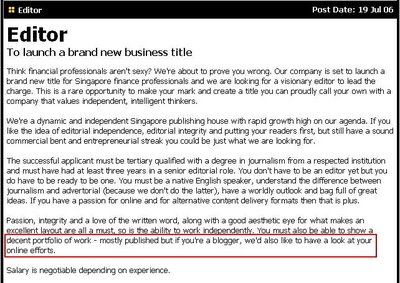
You must also be able to show a decent portfolio of work - mostly published but if you're a blogger, we'd also like to have a look at your online efforts.These days, online writing can be used for many purposes, and getting hired is certainly one noble way of using our writing skills to make a living!
Thursday, May 25, 2006
Dialogue

Take the example of the following transcripts. The original transcript is derived from an ordinary conversation between two persons who met each other in a shopping mall. There is nothing unusual about the conversation, but if written as is in a story, may be seen as boring.
ORIGINAL TRANSCRIPT
'Eh, hi, what brings you here?'
'Oh, I'm just running some errands here.'
'I see. Have you eaten?'
'Nope. Not yet.'
'Shall we have lunch together then?'
'Okay, but it will have to be somewhere near.'
'Sure, no problem. Let's go.'
The revised transcript, on the other hand, has been modified to include gestures, tones, and narratives to make the story more interesting and a worthwhile read.
REVISED TRANSCRIPT
It was lunchtime, and there were many people at the shopping mall. Nancy was about to go to a restaurant, when she saw David, her ex-colleague from Banque Nationale de Paris.
'Eh, hi, what brings you here?' David greeted Nancy in a sweet and sensuous voice.
'Oh, I'm just running some errands,' Nancy responded with a forced smile, her gesture revealing a reluctance to elaborate any further.
'I see. Have you eaten?' David asked.
'No, not really.'
'Shall we have lunch together then?' David continued, his tone mellowing to a beg, his face expressing hopefulness and longing.
'Well, alright, but it will have to be somewhere near,' Nancy replied in a relenting tone, feeling sorry for David who has been asking her out on a date for a very long time.
'Sure,' David brightened up immediately. 'Let's go.'
REVIEW
From the two transcripts above, it can be seen that by adding narrative to the dialogue, an ordinary conversation can be streamlined towards building up the climate for the story plot. This is done by painting in details the picture of what is not ordinary about the situation.
Sunday, March 26, 2006
Fiction Story - A First Attempt
After having traveled a day's journey by coach from Moscow, my wife Belle, and I finally arrived Suzdal, where we stayed overnight at an inn. The next morning after breakfast, we began our journey uphill to where our friends live.
The walk took two hours before we were near our destination. The small village town was covered entirely by snow, and the rooftops of the residential houses were totally white. All the surrounding trees were barren and without leaves. Belle and I hurried towards the houses on the snow-covered pathway as it was extremely cold even with heavy winter clothing. It was an hour past noon and the air was pleasantly sweet as the breeze gently blew at our faces. Belle and I were feeling excited, as we have been looking forward to meeting our friends for tea.
A short distance before we reach our friend's house, we heard the sound of tinkling bells and steps of some animals rushing towards the pathway, from a side road hidden from our view. Belle and I froze for a moment, and before I knew what I was doing, I have pushed Belle away from the pathway to avoid direct confrontation from whatever was coming.
A three-horse troika carriage suddenly appeared and came rushing towards me, and in that moment of shock, my mind flashed back memories of my past, then blank. I was no longer conscious.
"Honey, are you alright?" I heard my wife cried in my sub-consciousness.
"Adam, can you hear me?" a familiar voice spoke.
I tried moving my body, but was unable to. Then I tried to open my eyes, but it stayed shut.
"Adam, wake up! You've been unconscious for a week and your wife needs you," the familiar voice continued.
In my sub-consciousness, I knew I must wake up, because it hurts me to know my wife is hurting. I struggled and prayed, and in the next few moments, I felt my eyes blinked.
The walk took two hours before we were near our destination. The small village town was covered entirely by snow, and the rooftops of the residential houses were totally white. All the surrounding trees were barren and without leaves. Belle and I hurried towards the houses on the snow-covered pathway as it was extremely cold even with heavy winter clothing. It was an hour past noon and the air was pleasantly sweet as the breeze gently blew at our faces. Belle and I were feeling excited, as we have been looking forward to meeting our friends for tea.
A short distance before we reach our friend's house, we heard the sound of tinkling bells and steps of some animals rushing towards the pathway, from a side road hidden from our view. Belle and I froze for a moment, and before I knew what I was doing, I have pushed Belle away from the pathway to avoid direct confrontation from whatever was coming.
A three-horse troika carriage suddenly appeared and came rushing towards me, and in that moment of shock, my mind flashed back memories of my past, then blank. I was no longer conscious.
"Honey, are you alright?" I heard my wife cried in my sub-consciousness.
"Adam, can you hear me?" a familiar voice spoke.
I tried moving my body, but was unable to. Then I tried to open my eyes, but it stayed shut.
"Adam, wake up! You've been unconscious for a week and your wife needs you," the familiar voice continued.
In my sub-consciousness, I knew I must wake up, because it hurts me to know my wife is hurting. I struggled and prayed, and in the next few moments, I felt my eyes blinked.
Saturday, March 25, 2006
Nice Work - A Critical Book Review
The book being reviewed for this exercise is Nice Work, by David Lodge (1998). Most of you would have read it as part of the text prescribed by Monash for one of the units.
Nice Work essentially uses a comparison of the different thinking in academia and the industry to connect and form a balance perception of what is ideal and what is the ‘real’ world as a response to the outside world in contemporary life and society.
The purpose of Lodge’s writing in his book appears to advocate two points: the academia’s ability over industry expertise, and the subjection of man to woman. The book suggests that knowledge of businesses is not enough, and working smart is better. This may be seen in the fact that the lead male character in the book, Victor Wilcox, eventually has to ‘bow’ to Robyn for money in order to startup a new business and to keep his family alive.
This connotation in the theme is what I dislike about the book. It portrays the man as easily subdued by the opposite sex because of sensual desires. Victor is seen almost begging to be accepted by Robyn who is the ‘third’ party breaking up his family. Even though the story ends with Victor patching up with his wife, it essentially implies that Robyn still holds the key to his life (Lodge 1988:380).
‘I’m afraid I’ve been a bit foolish.’
‘I’ve been living in a dream. This business has woken me up. I must have been out of my mind, imagining you would see anything in a middle-aged dwarf engineer.’
‘You’re a very special person, Robyn,’ Victor says solemnly. ‘One day you’ll meet a man who deserves to marry you.’
The above quotes demean man in general, and as a theme of the story, this is disconcerting because it ‘attacks’ not only character, but also a particular gender. To be fair however, it must be said that the book is quite successful in the use of language, narrative structure and style, as it is highly readable and without complexity. The characters portrayed of the other supporting people in the story are believable, with some not at all likeable, such as, Charles and Brian Everthorpe.
From the way the narrative has been structured in Nice Work, together with the simple language and alluring easy-to-read style, David Lodge has successfully given sufficient reasons why readers will want to read his work, demonstrating the many facets of good writing, which include a believable plot, a sense of humour and irony, and the identification with ‘real’ characters in the academia and industry.
Reference
Lodge, D (1988), Nice Work. London: Penguin Books.
Nice Work essentially uses a comparison of the different thinking in academia and the industry to connect and form a balance perception of what is ideal and what is the ‘real’ world as a response to the outside world in contemporary life and society.
The purpose of Lodge’s writing in his book appears to advocate two points: the academia’s ability over industry expertise, and the subjection of man to woman. The book suggests that knowledge of businesses is not enough, and working smart is better. This may be seen in the fact that the lead male character in the book, Victor Wilcox, eventually has to ‘bow’ to Robyn for money in order to startup a new business and to keep his family alive.
This connotation in the theme is what I dislike about the book. It portrays the man as easily subdued by the opposite sex because of sensual desires. Victor is seen almost begging to be accepted by Robyn who is the ‘third’ party breaking up his family. Even though the story ends with Victor patching up with his wife, it essentially implies that Robyn still holds the key to his life (Lodge 1988:380).
‘I’m afraid I’ve been a bit foolish.’
‘I’ve been living in a dream. This business has woken me up. I must have been out of my mind, imagining you would see anything in a middle-aged dwarf engineer.’
‘You’re a very special person, Robyn,’ Victor says solemnly. ‘One day you’ll meet a man who deserves to marry you.’
The above quotes demean man in general, and as a theme of the story, this is disconcerting because it ‘attacks’ not only character, but also a particular gender. To be fair however, it must be said that the book is quite successful in the use of language, narrative structure and style, as it is highly readable and without complexity. The characters portrayed of the other supporting people in the story are believable, with some not at all likeable, such as, Charles and Brian Everthorpe.
From the way the narrative has been structured in Nice Work, together with the simple language and alluring easy-to-read style, David Lodge has successfully given sufficient reasons why readers will want to read his work, demonstrating the many facets of good writing, which include a believable plot, a sense of humour and irony, and the identification with ‘real’ characters in the academia and industry.
Reference
Lodge, D (1988), Nice Work. London: Penguin Books.
Subscribe to:
Posts (Atom)